Do I increase my risk of heart disease, by not taking HRT?

Do I increase my risk of heart disease, by not taking HRT?

January 2026

Menopause, Hormones & Heart Health

What does the Evidence Say?

Hormone therapy has become increasingly visible in conversations about menopause.  

Not only as a way to ease symptoms, but as a potential tool for long-term disease prevention.

Heart disease in particular often enters the discussion, given that women’s cardiovascular risk rises in midlife.

So it’s understandable that many women are asking: If oestrogen affects the heart, shouldn’t replacing it protect me?

A recent lecture (from Prof Susan Davis, endocrinologist and menopause researcher) exploring menopause, hormones, and cardiovascular health offers a clearer, and more nuanced look at the discussion.

The short version?

Hormone therapy can be life-changing for symptoms and quality of life. But it does not prevent heart disease. And women’s cardiometabolic risk is shaped long before menopause itself.
That might sound disappointing at first. In reality, it’s quietly empowering.

Oestrogen matters, but not as a cardiovascular cure

Oestrogen plays an important biological role in metabolism and vascular function in both women and men.

In situations of complete oestrogen deficiency (seen in rare genetic conditions or animal models) we see obesity, insulin resistance, and atherosclerosis.

But for the majority of us, menopause is not a state of total oestrogen loss.

Even after periods stop, oestrogen continues to be produced through peripheral conversion in fat, bone, and vascular tissue. This makes human menopause very different from the animal models often used in research.
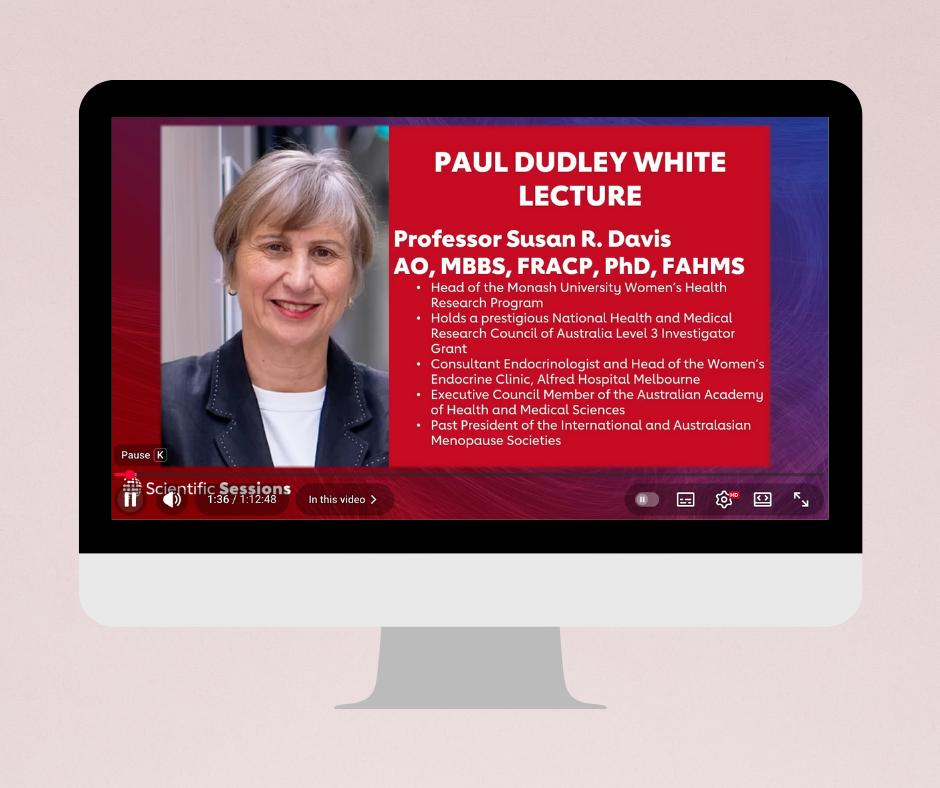
Watch the video from Prof Susan Davis

Or continue reading my summary, below


Hormone therapy does not prevent heart disease

Large, high-quality trials (including the Women’s Health Initiative) consistently show that menopausal hormone therapy does not reduce coronary heart disease or heart attacks.

Importantly:
  • There was no overall cardiovascular benefit
  • There was no harm in women who were younger or closer to menopause
  • Any small improvements in blood sugar were outweighed by factors like body fat and waist circumference
Key takeaway: Oestrogen should not be prescribed to prevent cardiovascular disease. 

Starting HRT earlier than symptoms begin, doesn’t guarantee you an advantage

You may have heard of the ‘timing hypothesis’. The idea that oestrogen is heart-protective if started early enough.

The evidence doesn’t support this in a strong enough way for medical guidelines to change (a nuance often lost on social media).

Studies where oestrogen was started within a few years of menopause show:

  • No meaningful reduction in real cardiovascular events
  • At best, small changes in surrogate markers, similar to what lifestyle changes can achieve
Key takeaway: Starting hormones early does not reliably prevent heart disease.

Important shifts happen before menopause

This is one of the most important insights from Prof Susan Davis’ lecture.

Many of the changes we associate with menopause actually begin during perimenopause, when oestrogen levels can still be relatively high:

  • Weight shifting toward the middle
  • Sleep becoming more fragmented
  • Increasing insulin resistance
  • Early vascular dysfunction
These shifts often accelerate before the final menstrual period, not after.
Which means that drawing a hard line at menopause misses the real window when risk is developing.

It would be a mistake to wait for symptoms of peri menopause to develop before considering the power of small and influential lifestyle change.

Key takeaway: Women’s cardiovascular risk is shaped long before oestrogen ‘drops’.

What does this mean for hormone therapy?

None of this means hormone therapy isn’t valuable.
It absolutely is.

Menopausal hormone therapy:

  • Is the most effective treatment for hot flushes and night sweats
  • Can improve sleep, quality of life, and day-to-day functioning
  • Can be used safely for symptom relief, even in many women with cardiovascular risk
Non-oral (transdermal) oestrogen, in particular, is associated with lowered health risk and is often preferred when risk factors are present.
There is no fixed expiry date. Continuation should be individualised.

Key takeaway: hormone therapy is for symptom relief and wellbeing, not disease prevention.

The bigger picture

Women’s cardiovascular health reflects a lifetime of influences, including:
  • Menstrual history
  • Chronic stress and emotional labour
  • Sleep disruption and shift work
  • Mental health
  • Socioeconomic pressures
  • Caregiving roles
These factors often peak before menopause, and they carry forward.

Hormones matter, inside a much larger life-course story.

This perspective reflects how I approach midlife health in my work. To support women with evidence, reassurance, and practical ways to feel more resourced in their bodies and lives.

"So what do this mean for me, at midlife?"

It means we stop looking for a single fix and accept what can be done now.

Hormone therapy can support comfort and quality of life. And for many women, that matters enormously. But long-term health is also shaped by how supported, regulated, rested, and resourced a woman feels in her life.

This isn’t bad news. It’s grounding.

Because it means there is far more within your influence than a prescription alone.

Clinical principle: Hormone therapy is a symptom-management tool, not a disease-prevention strategy.


Hormone therapy can be a valuable tool for symptom relief, but it is only one part of a much bigger picture.

In my work with women in midlife, I support a whole-system approach that combines evidence-based information with practical, compassionate support for this stage of life.

If you would like to explore that approach further, you can contact me here: info@angiegarton.com

I currently work with women one to one, and in small groups, both online and in person. 

If you’ve not yet joined my online community – Finding Yourself In Menopause – then check out the link below.

We are available to all women, at any stage of their midlife and menopause journey.


“I just want to feel like the old me”

“I just want to feel like the old me”

(August 2021)

It’s one of the most common phrases I hear;
“I just want to feel like the old me again”

Some women tell me they feel lost, drifting 
Many more women tell me they feel tired. 
Physically and mentally ‘tired in my bones’ and also ‘tired of’ doing all the things,
So yeah, no wonder you want to go back to how things were.

Now,  I know you value honesty and you’re willing to face facts, especially when there is guidance involved and not just cold reality.
If you’ve heard yourself saying ‘I just want to feel like the old me again’, and you’re also ready for my advice, then here it is…

Hormones have an influence on so many of the internal processes in your body/mind, I know you know that.
With hormonal shifts affecting neurotransmitters in the brain, and those shifts feeling unpredictable, of course you want to go back.

Most women tell me they ‘just know’ things are different inside, because they feel it. 

Thing is, trying to be the person you were, do the things you did in the way you did in your 30’s and early 40’s, without any respect for the shifts and changed going on inside? -it would literally be like swimming against the tide.
Doesn’t mean you can’t feel better, though. A lot better.

I’m certainly not advocating ‘getting old before your time’. 
I am definitely encouraging you to honour the changes that are happening now, and will continue to happen. 

There will always be change, in life and in your body.

I see these peri menopause years as a direct invite from Mother Gaia, to readjust, revise, reconsider what’s going on for you and why.
Allow her that invite, really look at it, consider what it could provide you with rather than what might be taken away.
Confidence, intuition, motivation, truly loving yourself,
It’s all there for the taking, when you know how.


Hey, I know it sounds a bit fanciful, but of all the women I’ve helped over the years, it’s the ones who are able to make these course corrections and adjustments
(to what they’re doing, to who they’re being),
the ones who start to take a deeper view of how to respect this time for themselves, 
they’re the ones who tell me how much better they feel.
They’re the ones I get messages from, to tell me how things are so much different for them now.
Not because they feel exactly the same as they used to, but because they’ve decided who they want to be.


Feeling better and more yourself is about allowing the change, not battling against it. 
It’s about understanding what’s happening and knowing what you can do. 
Don’t underestimate the confidence that can come from knowing you’re on the right path, in all ways. Personally, physically, mentally, nutritionally, spiritually.
How you feel, it’s not just about the hormones. 

We used to call it ‘the change’ here in the UK, and whilst I prefer to give ourselves the correct terminology, the concept is still true.
It is a time of change, of course it is. 
But all too often, it’s talked about in terms of unruly, unmanageable change.
Yeah, there is some of that involved but also, let’s not downplay the changes we can make ourselves.


In a body (and a life) that is constantly changing, feeling more ‘you’, isn’t necessarily about going back to how things were.
Rarely will anyone hold the same beliefs, values, goals and dreams their entire life. 
You change, you upgrade.
You’ve changed, you see, in so many ways. 

I know these current changes you’re going through aren’t all desirable or of your own choosing, but they do provide an opportunity.
To get really super clear on what’s important to you.
And oh my, what a platform on which to dive off, to live the next chapter of your life.


Honour this by serving yourself a huge slice of well deserved self-compassion.
And then by slowly and steadily making some decisions about your current direction – physically, mentally, emotionally, spiritually.
What’s right for you – now, at this time?
(we’ve been looking at this in more detail over in my membership group, get in touch if you want the details).


I know you just want to feel normal, more like you again.

If you’ve had enough of trying to make sense of it all on your own, get in touch.
Let’s take it step by step, together.

angie@bodyevolutionformula.com


The four most dangerous words for any woman going through menopause

The four most dangerous words for any woman going through menopause

Not many women ask me about menopause directly, but they do ask me about;

-how to get rid of the uncomfortable weight around the middle,

-how to sleep through the night,

-how to have more energy,

-how to stop feeling such rage and irritation

So we could say, it’s not menopause itself that’s the problem, it’s the symptoms that are associated with it.

Especially when we really get talking about what’s really going on, namely:

-Not feeling attractive and worrying that your partner feels the same way

-Hating yourself and who you’re becoming (my client’s words, not mine)

-Fearful that it’s only going to get worse / not knowing when it’s going to improve

-Losing confidence

-A dwindling interest in the things that used to bring joy and pleasure

-Feeling lost within yourself

-Worrying about heart and brain health (that HRT is often said to solve)

I can help you with all those things, in our online community (Finding Yourself In Menopause)

But there’s another problem.
Because when we talk about symptoms, there’s a tendency to talk a lot about hormones, the decline, the changes, the deficiencies, the imbalances.

Which is fine, but the thing is – if I only focus on the hormones with a client, the symptoms will persist and she will NEVER feel the way she really wants to about herself.

How can this be true?

Allow me to introduce to you, the four most dangerous words….

“It’s. Not. That. Bad”

Why so dangerous?

Because those four little words keep you stuck in the concentric circles within yourself.

If you say those words to me, I already know I can’t help you with whatever we’re talking about, because you’ve decided (and I respect your choice) that you’re going to tolerate whatever problem you’ve got.

And that’s a real shame, because we both know, it won’t go away on its own.

I know it’s a coping mechanism, a way to get through the week, you’re just trying to live your life.

But at the end of the day, tolerating stuff, just keeps you stuck.

I can talk about this with clients in detail because I’ve had so much experience of it over the years – with myself!

I can also say; opening pandora’s bs box, admitting you need to do something about a problem, takes courage and then strategy, so that you don’t end up fuelling the fire of self-loathing.

So my advice to you right now, is to start noticing when you hear yourself saying something like ‘it’s not that bad’

It might also be disguised and show up as;

“I’m fine” (usually accompanied by an avoidance of eye contact, lol)
“I’ve no real reason to feel like this”
“I’ve been through worse”

These are all alarms and warning lights that come on when something is being ignored, missed, tolerated at the expense of your life experience!

Before you decide whether you’re going to change your mind on that, or not. Before you decide what you might be able to do about it, try to notice when it appears and ask yourself if it’s really true.

I’m here ready to help you with the rest.

Want to continue this conversation?
You could join my online community, take a course or have a one to one conversation with me.
Details at this link

What can I expect to happen?

What can I expect to happen?

May 2020

I remember asking what it would be like, to jump out of an aeroplane.

The instructor gave the textbook answer in a calm and reassuring voice, and then proceeded to continue the training for it. 

Truthfully, he didn’t know. He would never know.

He knew what it felt like for HIM to jump out of the plane.
But he couldn’t really answer for me. 

He didn’t know how my body, my brain would react. I had to experience that for myself. 

Sure, you can hypothesis, you can prepare for it, even watch videos of others doing it and almost feel like you’re right there.

But at the end of the day, as I floated down to the ground, the instructors voice crackling over the radio, it was my experience
(and I was so glad to have him there!).

Don’t let anyone -ever- tell you what you’re going to feel or experience, in menopause.

Sure, we can talk about the common symptoms and the statistics and the ‘many women feel…’
Yes that can be useful to get an idea. But it isn’t set in stone.

They might know you well, you might share some genes (or even jeans),
but your menopause is Your Menopause.

Some women describe it to me as if they’ve unwillingly jumped out of a plane and now desperately scrabbling around, trying to open their parachute.
Other women say they’ve finally found their own wings. 

And yeah, there’s plenty more in between.

When women say to me;
‘what can I expect to happen?’

I can reel off a list of all the biological goings-on.
I’m willing to bet my last avocado that you’ve already googled a few lists of symptoms.

But how if affects you, what symptoms you might get – I really can’t say for sure. Nobody can.

My job, my role, is to help you to prepare (because you really can prepare) and understand what’s happening. Then, even if it gets confusing and difficult, I’ll never leave you to fall.
I’ll help you deal with it.

I’m the reassuring voice, the calm in the storm, the voice of reason, the practical one with answers, and strategies grounded in science, not pulled from the clouds. 

Your menopause is yours, but it doesn’t mean you have to go it alone.

Have you read my free guide yet?….

Click here to get access